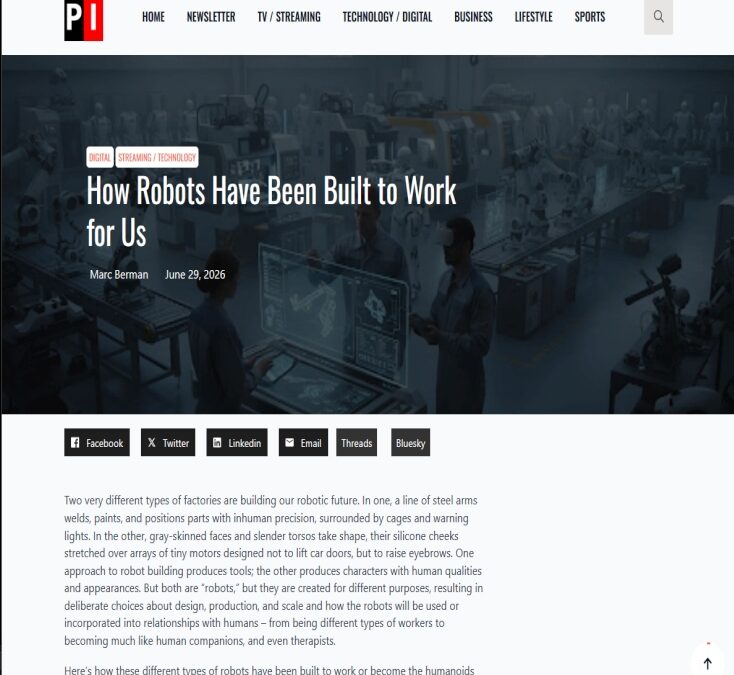
Two very different types of factories are building our robotic future. In one, a line of steel arms welds, paints, and positions parts with inhuman precision, surrounded by cages and warning lights. In the other, gray-skinned faces and slender torsos take shape, their silicone cheeks stretched over arrays of tiny motors designed not to lift car doors, but to raise eyebrows. One approach to robot building produces tools; the other produces characters with human qualities and appearances. But both are “robots,” but they are created for different purposes, resulting in deliberate choices about design, production, and scale and how the robots will be used or incorporated into relationships with humans – from being different types of workers to becoming much like human companions, and even therapists.
Here’s how these different types of robots have been built to work or become the humanoids among us.
Factory Muscle: How Industrial Robots Are Designed and Built
If you think of robots as products, the modern industrial robot is composed of a set of rigid links and rotary joints to create an articulated metal skeleton optimized to move tools through space as quickly and precisely as possible. Designers begin in computer-aided design or drafting (CAD) to digitally create precise 2D drawings and 3D models of physical objects before they are manufactured or constructed. To this end, they sketch a kinematic chain that describes the motion of points, objects, and systems of groups cause the motion. In other words, they begin by focusing on the geometry of movement by analyzing position, displacement, velocity, and acceleration. In particular, they are interested in mapping out the construction and movement of each part of the robot, from its feet to its head. In doing so, each joint is assigned a range of motion; each link gets a length and cross-section that must balance stiffness against weight.
From there, mechanical engineers simulate how the feet and legs will move across the floor and over any obstacles or barriers along the way, as well as how its arm will move under loads of different weights. They model worst-case scenarios: a fully extended arm holding a heavy welding gun, or a gripper swinging a car door. The motors must generate enough torque to move those loads quickly, the gearboxes must survive millions of cycles, and the whole structure must resist vibrations that could ruin precision.
Once the design is frozen, production begins to look like any high-end industrial product. Steel and aluminum billets are machined into links. Gearboxes are designed and manufactured, such as harmonic drives, a mechanical gear system designed for its exceptional precision, or high-precision planetary gears, which are designed with a central “sun” gear, orbiting “planet” gears, and an outer “ring” gear. At the same time, cables and hoses are cut to length, labeled, and bundled.
In assembly, technicians build up each joint as a module consisting of a motor, gearbox, position sensors, seals, and housings, all bolted together and tested before being attached to the next link. The final arm is wired with power and data buses, which are a physical pathway or set of wires in a computer that transfer data between hardware components, such as the CPU, memory, and peripherals. It’s like creating a digital highway that carries information from one place to another in the robot. Then, that bus is mated to a controller cabinet that houses various devices. These include inverters, which are electrical devices that convert Direct Current (DC), typically stored in batteries or generated by solar panels, into standard Alternating Current (AC) used to power household appliances and electronics, along with safety relays and a real-time computer. Then, the technicians set up calibration routines that teach the controller exactly where each joint’s zero position lies, so the software knows where the arm is in three-dimensional space down to fractions of a millimeter.
All of these parts of the robot are combined together with a goal of predictable movement. Industrial robots are most profitable when they act as expected and nothing surprises them. Their “intelligence” derives from the offline programming, whereby engineers define paths, speeds, and timing down to the millisecond, then the robot repeats them endlessly.
Scale has turned this creation and production of robots into a global industry. According to the International Federation of Robotics (IFR), factories worldwide installed about 542,000 industrial robots in 2024 alone — more than double the annual installations of a decade ago. By the end of that year, the total stock of industrial robots in operation reached roughly 4.66 million units, with Asia (and especially China) leading adoption. In other words, there are now more industrial robots at work than there are people in some mid-sized countries. And this number has grown even more in 2025 and 2026.
Behind those numbers are hundreds of manufacturers, from global giants to niche suppliers. A recent IFR press conference highlighted that the industrial robotics market is on track to reach hundreds of billions of dollars over the next decade, with articulated arms dominating factory automation and collaborative robots growing fastest in flexible manufacturing sites.
What doesn’t show up in the topline statistics showing the company’s total revenue or gross sales are the design compromises. An arm optimized for speed in an automotive plant might be too dangerous to place next to a human worker. That is where a newer species of industrial robot comes in: the cobot.
Cobots: Redesigning Industrial Robots for Shared Work
Collaborative robots, or cobots, start with the same basic anatomy as traditional industrial arms, which include links, joints, and motors, but they are engineered to share space with people.
Where a classic robot might have thick steel links and oversized motors, a cobot tends to be lighter, with rounded edges and integrated torque sensors in its joints. These sensors constantly monitor the forces the arm experiences. If a cobot collides with a human arm instead of a metal part, the controller can detect the unexpected force spike and stop within milliseconds.
Designing this kind of “safe” behavior is an exercise in layered constraints. Mechanical engineers limit the maximum speed and torque of each joint. Control engineers implement safety-rated stop modes and collision detection algorithms. Software engineers add virtual “safety planes” and zones, defining invisible walls in the robot’s work envelope that it must not cross unless conditions are met.
The production of cobots looks similar to that of traditional arms, but the mix of components changes. You see more joint-level torque sensors, more complex safety controllers, and often integrated user interfaces that let operators “teach” the robot by hand, such as from a tablet or by physically guiding its arm through motions. The goal is not just to be safe but to be approachable, so that a factory worker without a robotics degree can reprogram a task whenever it is suddenly needed.
This push toward collaboration is part of the broader industrial picture. The IFR notes that industrial robot installations have doubled over the past ten years, even as robots become more connected and integrated into “smart factory” environments. Cobots and AI-enabled systems are key enablers of that shift, allowing robots to move onto shared lines where workers and machines divide labor more flexibly.
In one sense, cobots are a halfway point between the pure industrial tool and the humanoid. They are still unapologetically mechanical, but their bodies and behaviors are tuned to coexist with human motion, not exclude it.