Read the Full Article at Big News Network.com
Meta’s latest shift from being a social media behemoth to an AI-first conglomerate is not just a branding move-it is another case study in how the company chases profit and data while externalizing risk onto users, workers, and local communities. This evolving pattern strengthens the argument that meaningful government regulation is necessary.
The AI shift to data centers, layoffs, and worker surveillance
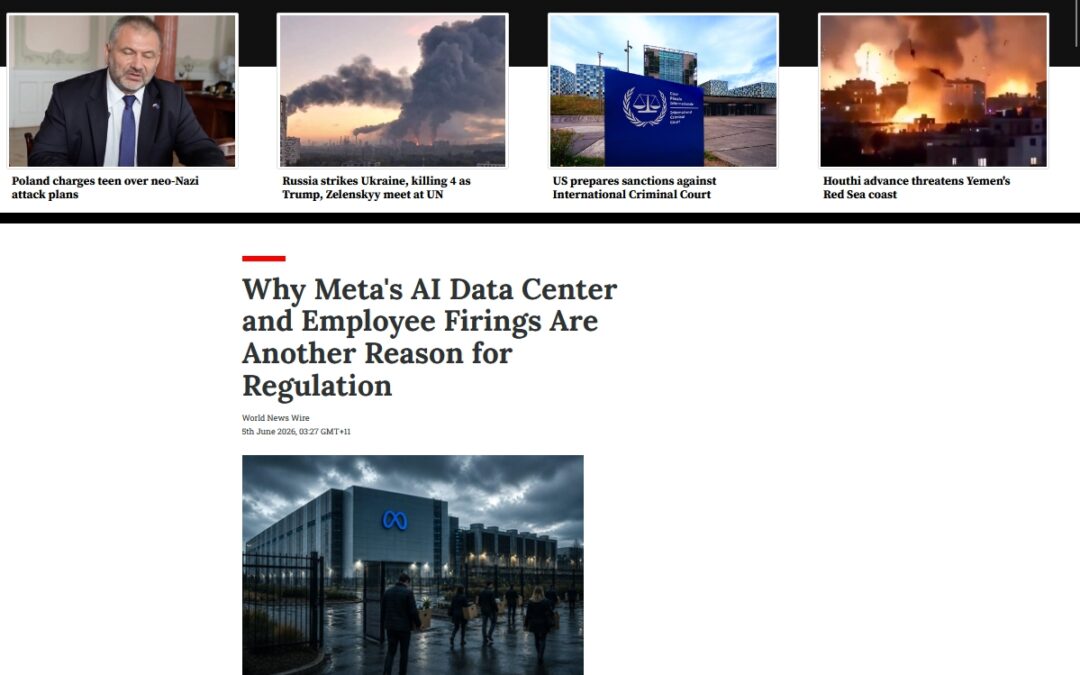
Meta is now pouring billions into artificial intelligence, and the shift is visible on three fronts at once. It is creating new AI data centers, firing workers in mass layoffs, and making plans to capture detailed employee data to train its models.
Recent reporting shows that Meta is cutting around 8,000 jobs, about 10 percent of its workforce, claiming these cuts are to “offset” the massive costs of its AI buildout and its investments in new data centers. Some of those cuts include data center staffers, while the company has accelerated construction and reallocated around 7,000 remaining workers into AI roles. In other words, Meta is reshaping its labor force to serve AI, not the other way around.
At the same time, internal plans call for closely monitoring and logging how employees perform everyday computer tasks, so that these workflows can be fed into machine learning systems. Workers are not wrong to see this as a kind of digital scientific management known as Taylorism, an early 20th-century theory developed by engineer Frederick W. Taylor. Back then it was designed to maximize economic efficiency and labor productivity by systematically breaking down complex tasks into small, repetitive steps, standardizing workflows, and using performance-based financial incentives. In this case, the system is applied to the workers’ keystrokes, clicks, and onscreen behavior to use that information to create models that could eventually automate pieces of their own jobs. In response, many workers have expressed anger and resentment, seeing the data collection as a privacy invasion on top of contributing to their job insecurity as AI takes over parts of their jobs.
Plus the data centers have led to the outrage of communities as well. That’s because large AI data centers consume enormous amounts of electricity and, often, water for cooling, yet they do not necessarily deliver many long-term jobs relative to their footprint. Locals living near proposed or expanding Meta facilities have raised concerns about becoming sacrificial “AI zones,” so a distant platform can train ever-larger models while creating environmental and infrastructure havoc.
Taken together, this new venture of Meta tells a familiar story in a new setting whereby Meta extract value in the form of data, labor, land, and attention, while others, in this case, workers and community members, absorb the costs.
A company already in court over teen harms
This shift to AI lands on top of Meta’s already serious legal exposure over how its products affect young people. More than 40 U.S. states have sued Meta, alleging that Facebook and Instagram were deliberately engineered to addict teens and children, fueling a youth mental health crisis. These suits accuse Meta of designing and deploying features, such as infinite scroll and constant notifications, with full knowledge that they could drive compulsive use and psychological harm in minors, while downplaying those risks in its public messaging.
In March 2026, a jury in a landmark Kaley case found that Meta, along with YouTube, harmed a young user with addictive design features that contributed to her mental distress, awarding$6 million in damages. That verdict does not settle all the pending litigation, but it confirms in a courtroom what parents and advocates have been saying for years: Meta’s product design choices can injure real people, particularly vulnerable teens.
Seen against that backdrop, Meta’s new AI strategy is an extension of the same growth-at-all-costs model: build systems that maximize engagement, data, and monetization first; worry about downstream human consequences later.
Profiting from scams and overwhelming users with ads
Meta’s ad system tells a similar story about increasing the profit line at the expense of users.. Internal documents reviewed in a major investigation showed the company expected around 10 percent of its 2024 revenue, an estimated tens of billions of dollars, to come from ads tied to scams or banned products. Another lawsuit filed by consumer advocates alleges Meta knowingly allowed widespread scam advertising, helping fraudsters steal at least $2.7 billion from users between 2021 and 2023 while continuing to receive the ad payments.
One especially disturbing detail from internal materials is that Meta’s systems often do not remove suspicious advertisers unless they are 95 percent certain they are scammers; instead, they may simply charge those advertisers higher prices to run their ads. In practice, that means bad actors can keep paying to reach users, while Meta profits even from clearly risky promotions.
Meanwhile, legitimate users and small businesses report the opposite experience. Ads can be rejected with little explanation, refunds are rare or difficult to obtain, and there is often no live support to resolve mistakes. Users also describe feeds that feel saturated with ads that feature repetitive promotions, questionable offers, and low quality content that crowds out posts from friends and communities.
Again, the pattern is consistent: Meta’s systems err on the side of revenue, even when that means enabling fraud or flooding people’s feeds, while honest advertisers and everyday users bear the costs.
Arbitrary enforcement and users locked out
Meta’s approach to enforcement and identity verification has become another major pain point. Users report losing access to Facebook or Instagram accounts after selfie-based verification fails, or when they are wrongly flagged by automated systems as violating “community standards.” In many cases, appeals are slow, opaque, or functionally nonexistent, leaving people cut off from personal histories, professional pages, or community networks they spent years building.
This loss of an account is particularly damaging for small businesses, creators, and activists who rely on their accounts as central to their online participation. When something goes wrong, whether due to a glitch, a false positive, or a mistaken moderation decision, the burden falls on the user, not Meta, to navigate an often impossible support maze. Commonly, the loss of an account is final, since it is very difficult if not impossible to appeal, and contact with a real human to navigate an appeal is normally not an option.
AI-heavy systems tend to magnify this problem. When more decisions are delegated to algorithms trained on opaque data, it becomes harder for users to understand why they were punished, what they did “wrong,” or how to fix it. Meta’s aspiration to capture and automate even more behavior data, including from employees, risks deepening a regime where the company’s models are powerful, and its accountability is limited.
One through-line: profit over people
What ties all of these threads together – the AI data centers, the layoffs and employee monitoring, the teen harm lawsuits, the scam heavy ad ecosystem, the arbitrary account shutdowns – is a single through-line: Meta consistently optimizes for growth and monetization, even when that clashes with the interests of users, workers, and communities.
In the case of Meta’s shift to AI, this focus on profits while downplaying human concerns results in the following detrimental effects:
Locals get the environmental and infrastructure risks of massive data centers.
Employees face job cuts plus invasive data capture aimed at automating their tasks.
Users get more opaque, automated systems that are harder to challenge or understand.
At the same time, the company continues to defend itself in court against accusations that it has designed addictive experiences for teens and has failed to warn families about the dangers, even though a jury has already found that its features contributed to a young user’s mental health crisis in the Kaley suit. It is also fighting a lawsuit filed by Santa Clara County in California over profiting from fraud, while internal documents highlight just how lucrative the scam and “high-risk” ads have been on its platforms.
None of these are one-off mistakes. They are the predictable byproduct of a corporate structure that rewards attention, data, and revenue above all else.
Why regulation is now unavoidable
Given all these harms to users, employees, and community members, regulation is crucial. For years, Meta argued that it could police itself with internal policies, advisory boards, and transparency reports. But the expanding list of harms and lawsuits, plus now Meta’s aggressive turn to developing an AI system, suggests that self-regulation has failed.
Regulators and lawmakers now have multiple, concrete fronts on which to enact legislation and establish civil and even criminal penalties for engaging in certain actions. In particular, this legislation should cover the following:
Establishing youth protection and design standards.Laws can require that platforms serving minors avoid addictive design patterns, provide meaningful safeguards, and surface real warnings about mental health risks.
Requiring ad integrity and fraud liability.Rules can hold platforms liable when they knowingly reap large profits from scam advertising and require platforms to provide transparent, fair processes for advertisers to avoid rejecting or misclassifying their legitimate campaigns and to pay them compensation or a penalty for doing so.
Providing due process for users.Platforms as large and essential as Meta should be obligated to provide clear explanations, accessible appeal pathways, and timely remediation when accounts are wrongly disabled or content is removed for no good reason.
Creating labor and data rights in AI.Governments can set boundaries on how employers collect and use behavioral data, especially when that data is used to build systems that could replace workers; and the government can require bargaining or consent with workers around such
Offering local and environmental oversight of data centers.Communities should have real leverage over the siting, resource usage, and longterm commitments involving a data center in a city or county, before an AI data center is established there and reshapes the area.
Meta’s rapid transition into an AIcentric corporation makes these questions even more urgent now, especially since the company is already under fire for addicting teens, profiting from scams, mishandling user accounts, and flooding feeds with ads. Now that Meta is now racing to build even more powerful and less transparent systems atop vast new data reservoirs, the government should carefully assess what the company is doing and establish boundaries, rules, and regulations to guide and limit what it is doing. This is especially critical now more than ever because of the scale of these AI developments, including building the data centers, that affect so many millions of people, from employees and users to community members in cities and counties around the U.S.
At some point, this pattern of inflicting harm on the public while seeking to maximize revenue stops reflects more than a series of unfortunate incidents and is a direct result of the company’s business model. So this is exactly the point at which a government with democratic institutions is supposed to step in to regulate the company and penalize it for the harms it causes.