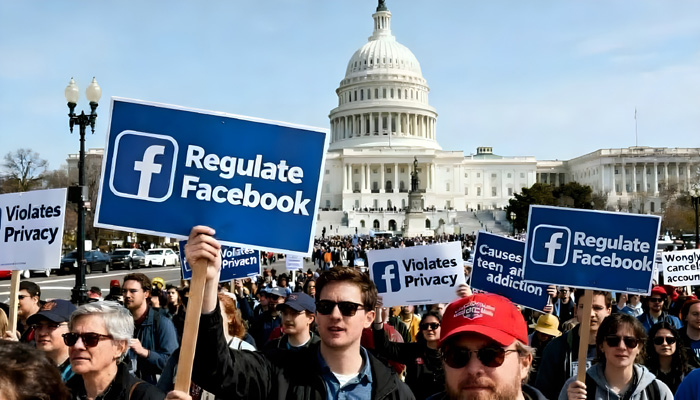
Now that a New Mexico jury has just ruled that Meta harmed children’s mental health and concealed what it knew about child exploitation, it provides further support for a just launched campaign to write to Congressional lawmakers to regulate Meta.
The campaign features a national letter-writing initiative aimed at U.S. senators and congressional leaders on technology, trade, small business, and justice committees that addresses a variety of Meta’s practices including protecting children and teens.
The campaign’s four aims include passing the following regulations:
- Develop youth safety standards to address social media addiction and mental health harms.
- Investigate Facebook and Meta’s user treatment policies, particularly concerning wrongful account suspensions and the lack of an appeal process.
- Establish stronger privacy protections, requiring transparency in how user data is collected and monetized.
- Ensure fair ad practices, including transparent refund mechanisms for rejected ads and advertising oversight.
A key goal of the letter writing campaign is to make sure Washington hears from real users and small advertisers who have suffered from Meta’s unchecked power. The organizer of the campaign is author Gini Graham Scott, PhD., who has released a new book, The Latest in the Campaign Against Facebook, calling for urgent government regulation of Facebook and its parent company, Meta Platforms. The book carefully documents the numerous harms caused by the company’s practices, from privacy violations and youth addiction risks to arbitrary account takedowns and deceptive advertising policies.
Scott’s work builds on growing public outrage and legal challenges that paint a troubling picture of Meta’s disregard for user welfare and accountability.
Her research highlights several pressing cases:
Youth Harm and Addiction: In the Kaley case, a 20-year-old woman in Los Angeles has filed a lawsuit against Meta’s Instagram, claiming the platform’s algorithmic design was deliberately optimized for engagement at the cost of her mental and physical well-being. The case, largely ignored by mainstream media, could set a major precedent if Meta is held liable.
Privacy Violations: Meta faces ongoing litigation alleging systematic invasions of user privacy from the 2018 Cambridge Analytica case to recent cases in which Meta was charged with harvesting personal data beyond user consent for profit and behavioral targeting.
Teen Mental Health Claims: Dozens of families have joined national lawsuits accusing Meta of knowingly designing products addictive to teens while ignoring internal research linking Instagram use to depression and body image issues.
Scott also describes widespread technical and operational abuses impacting millions of users: the flawed “selfie verification” program that locks out legitimate users, algorithmic account suspensions with no real appeal process, and an onslaught of personalized ads that overwhelm user feeds. Meanwhile, some advertisers report losing funds, including one business owner who claims Facebook refused to refund over $1,000 he spent on rejected ads.
As Scott argues, “Congress and the White House must act. Social media companies like Meta wield near-monopolistic control over communication, commerce, and influence. Without regulation, users — and society as a whole—are the collateral damage.”
For media inquiries, interviews, or review copies of The Latest in the Campaign Against Facebook, please contact:
Susan Andrews
Executive Assistant
American Leadership Books
c/o Changemakers Publishing
San Ramon, CA 94583
(925) 804-6333
changemakerspublishingandwriting.com